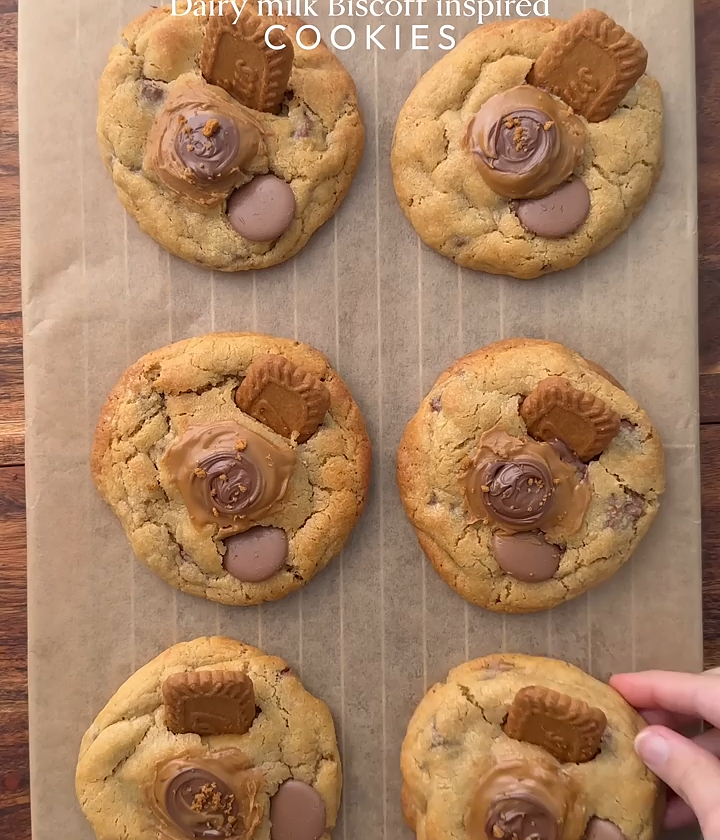
These cookies are stuffed with a frozen core of Biscoff and chocolate spread that melts into the center as they bake. The dough itself has Biscoff spread mixed in, so every part of the cookie tastes like the biscuit. Plan on 2.5 hours total, most of which is waiting for the filling and dough balls to freeze.
This recipe draws from the Cadbury Dairy Milk Biscoff bar, which put caramelised biscuit and chocolate together into something people couldn’t stop buying. Biscoff spread goes into both the dough and the frozen filling, not just the center like most stuffed cookies. That’s what makes the Biscoff flavor run through every bite.
The most important step is freezing the filling solid before it goes into the dough. If it isn’t fully frozen when you bake, it leaks out the sides before the dough sets. Freeze the little Biscoff and chocolate spread parcels for at least an hour, and ideally overnight for a cleaner melt.
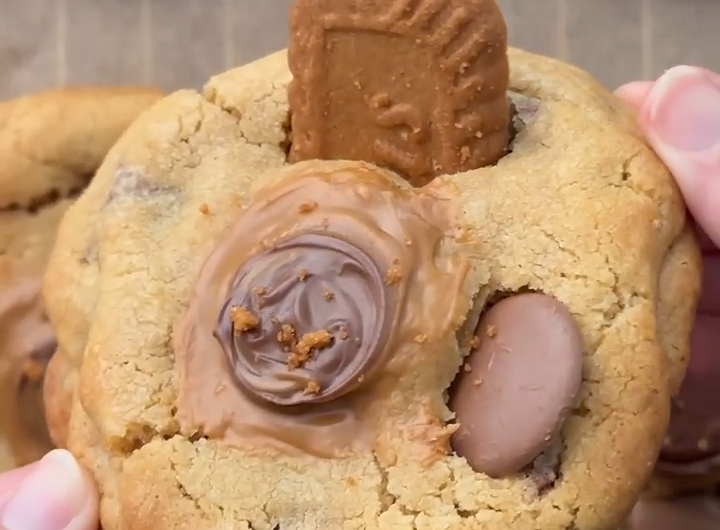
Dairy Milk Biscoff Inspired Cookies
Course: Italian Dessert Recipes8
servings30
minutes15
minutes530
kcalThick, chewy cookies packed with chocolate chips and a molten Biscoff-and-chocolate center that forms from a frozen filling hidden inside each dough ball. Most of the 2.5-hour timeline is passive freezing, not active cooking.
Ingredients
115g unsalted butter, chopped
60g caster sugar
80g light brown sugar
100g Biscoff spread
1 whole egg + 1 egg yolk
¼ tsp salt
1½ tsp baking powder
¼ tsp baking soda
½ tsp vanilla bean paste
250g-260g plain flour
150g chocolate chips or chunks
Biscoff spread, for filling
Chocolate spread, for filling
Directions
- Cut cling wrap into small squares. Scoop ½ tsp Biscoff spread and ½ tsp chocolate spread onto each square. Fold to seal and freeze until completely solid, at least 1 hour. Repeat for each cookie you plan to make.
- In a large mixing bowl, whisk the chopped butter until slightly creamy. Add both sugars and whisk until combined. Add the whole egg and yolk and whisk until fully incorporated. Add the Biscoff spread and vanilla bean paste and mix again.
- Add the baking powder, baking soda, and salt. Gently mix. Add the chocolate chips, mix, then add the flour and mix until just combined. Do not overmix.
- Portion the dough into 90g balls. Press a frozen filling parcel into the center of each ball, seal well, and roll smooth.
- Place the dough balls on a tray and freeze for at least 1 hour, or overnight for best results.
- Preheat a fan oven to 175-180°C (350°F). Bake for 10-15 minutes until the edges are lightly golden and the centers still look soft.
- Remove from the oven and cool completely on the tray.
- Decorate with half a Biscoff biscuit, Cadbury buttons, a swipe of Biscoff and chocolate spread, and Biscoff crumbs.

FAQ
Why does the filling leak out even when I freeze it overnight?
The filling escapes when the cling wrap isn’t sealed tightly enough, leaving gaps where the spread seeps out once it heats up. Fold it into a compact, airtight square with no air pockets, as if you’re wrapping something you don’t want to open. A loose parcel in the freezer means a leaky cookie in the oven.
Can I use crunchy Biscoff spread instead of smooth?
Crunchy Biscoff works in the dough but creates a slightly grainy center because the biscuit pieces don’t melt as cleanly as smooth spread does. Use smooth for the filling parcels and crunchy in the dough if you want both textures. The combination of a clean molten center and a textured dough is worth trying.
How do I know the cookies are done if the centers still look raw?
Pull them out when the edges are set and lightly golden but the centers still look underdone. The residual heat from the tray finishes cooking the middle as they cool. If you wait for the centers to look done in the oven, the edges will be overbaked.
Do I have to use both Biscoff and chocolate spread in the filling?
You can fill the parcels with just Biscoff spread and they’ll still work. But the chocolate spread is what makes the center taste like the Dairy Milk Biscoff bar these cookies are based on. Keep the total filling volume the same if you swap one out, so the parcel freezes into the right size for the dough ball.
Why does the recipe use both baking powder and baking soda?
Baking powder provides lift and keeps the cookies thick, while baking soda promotes browning and helps the edges spread just enough. Using only one leavener pushes the cookie toward either too puffed or too flat. Together they’re what keeps these thick and chewy without going cakey.
Why do the dough balls need to be frozen before baking?
Chilling the dough balls slows down how fast the butter melts, which stops the cookies from spreading flat before the structure sets. Room-temperature dough hits the oven already soft, so it spreads wide before the edges firm up. Starting from frozen gives the outside time to set before the inside fully melts, which is why these stay thick.