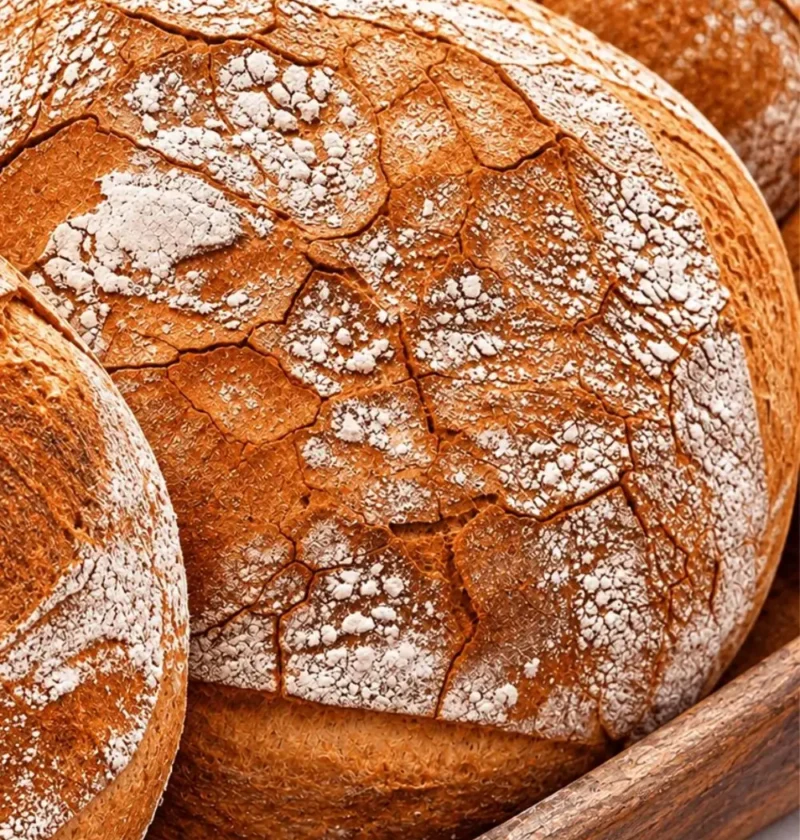
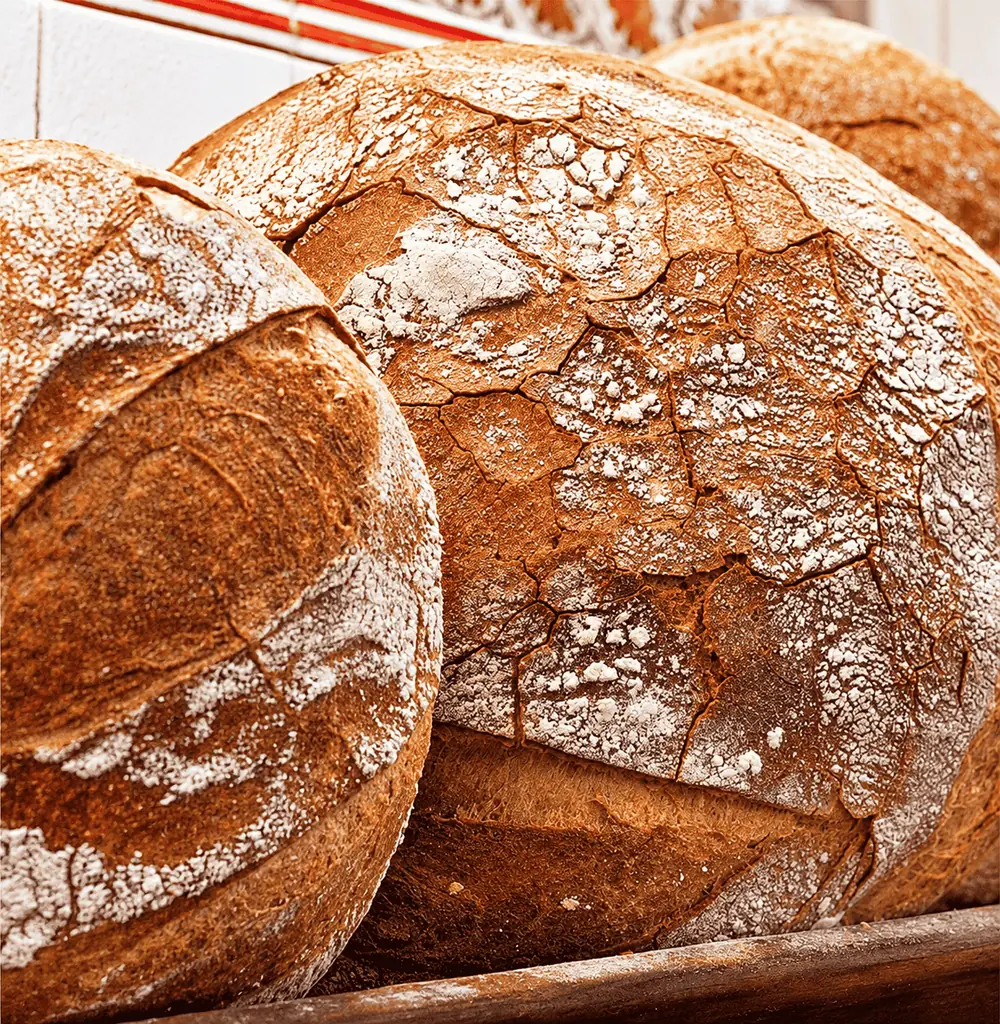
Pugliese bread (pane pugliese) is a rustic Italian bread of biga, flour and water, ready in 6 hours 15 minutes. It makes 2 large or 3 smaller loaves with a crackly crust, so you can freeze one for later.
Why This Recipe Works
The biga does most of the flavor work. This fermented starter gives the bread a slightly tangy, wheaty taste that plain yeast dough can’t match. A small pinch of yeast on top makes sure the loaves still rise on schedule.
The dough is very wet, so it stays soft and sticky instead of stiff. That water turns to steam in the hot oven and opens up a chewy crumb with big, uneven holes. Don’t add extra flour to the dough itself, only to the work surface.
Pressing your fingertips into the loaves right before baking pushes out the big gas bubbles and leaves shallow dimples. Baking on preheated stones then hits the bottom with strong heat, which gives you a crisp crust that sounds hollow when you tap it.
Pugliese Bread (Pane Pugliese) Ingredients
- 1 1/4 teaspoons (3.5 g) active dry yeast
- 1/4 cup (60 g) warm water (105°F to 110°F / 40°C to 43°C)
- 3 cups (720 g) room-temperature water
- 3/4 cup plus 1 tablespoon (200 g) biga (Italian fermented starter)
- 7 cups plus 2 tablespoons (1 kg) unbleached all-purpose flour, plus extra for dusting and shaping
- 4 teaspoons (20 g) kosher salt
- Yellow cornmeal, for dusting the baking stones
How To Make Pugliese Bread (Pane Pugliese)
Make the dough
- Bloom the yeast: Stir the yeast into the 1/4 cup warm water, 105°F to 110°F (40°C to 43°C), in the bowl of a stand mixer. Leave it for about 10 minutes, until foamy and creamy, which tells you the yeast is alive.
- Add the biga: Pour in the 3 cups room-temperature water and drop in the biga. Beat with the paddle attachment until the mixture is smooth, so the starter spreads evenly through the dough.
- Mix in flour and salt: Add the flour and salt and mix on low speed for 1 to 2 minutes. The dough should turn soft and elastic, pull away from the sides of the bowl, and cling a little to the bottom.
- Knead by hand: If you like, turn the dough onto a floured surface and knead it gently with floured hands for about 1 minute. It’s ready when it feels velvety and is no longer tacky.
Let it rise and shape the loaves
- First rise: Move the dough into a large, lightly oiled bowl or dough tub. Cover it tightly with plastic wrap or a lid and leave it at room temperature for about 3 hours, until it has tripled in volume.
- Flour the surface: Dust your work surface and a bench scraper generously with flour. Keep a small pile of extra flour nearby for your hands.
- Divide the dough: Pour the risen dough gently onto the floured surface and dust the top lightly with flour. Cut it into 2 equal pieces for large loaves or 3 equal pieces for smaller ones.
- Pre-shape: Flatten each piece gently, then roll it into a snug log and tuck the dough in with your thumbs as you go. Turn the log a quarter turn, flatten it once more, and roll it up again.
- Form the rounds: Cup your hands around each piece and drag it gently across the unfloured part of the counter. The friction builds surface tension and shapes a tight, smooth round loaf (boule).
- Second rise: Set the loaves on parchment-lined baking sheets or floured pizza peels. Cover them with a heavy kitchen towel and let them rise for about 1 hour, until doubled in size.
Dimple and bake
- Heat the oven: About 30 minutes before baking, put baking stones on the oven racks and preheat the oven to 450°F (230°C). The stones need that time to get fully hot.
- Dimple the loaves: Dust the tops lightly with flour and press your fingertips gently into the surface all over to make shallow dimples. Rest the loaves uncovered for 5 to 10 minutes, until the dough feels very soft and springs back gently.
- Load the oven: Sprinkle the hot stones lightly with cornmeal and carefully flip each loaf onto a stone, floured side up. If you have no stones, bake the loaves right on the baking sheets.
- Bake until crisp: Two large loaves need 50 to 60 minutes, and three smaller ones need 30 to 35 minutes. You want a deep golden, crisp crust. Tap the bottom, and if it doesn’t sound hollow, give the loaves a few more minutes.
- Cool completely: Move the loaves to wire racks and let them cool all the way before you slice. The crumb is still setting inside, and cutting early makes it gummy.
Recipe Tips
- Keep the dough wet: It will feel sticky and loose, and that’s right. Adding more flour to the dough makes a dense loaf, so use extra flour only on your hands and the counter.
- Watch the dough, not the clock: The first rise is done when the dough has tripled in size, and the second when it has doubled. A cold kitchen can add time, a warm one can cut it.
- Handle the risen dough gently: Pour it out and shape it with a light touch. Rough handling pushes out the gas that gives the crumb its open holes.
- Don’t skip the hot stones: Strong heat from below is what crisps the bottom crust. If you bake on sheets instead, expect a slightly softer base.
What To Serve With Pugliese Bread (Pane Pugliese)
Tear a warm piece and dip it in good olive oil, or slice it for bruschetta. It also soaks up the sauce from a bowl of pasta or a pot of Italian soup very well.
How To Store
- Counter: Keep a cut loaf cut side down on a board, or in a paper bag, for up to 2 days. A plastic bag softens the crisp crust.
- Freezer: Slice a fully cooled loaf, wrap it well, and freeze it for up to 3 months. Thaw at room temperature.
- Reheat: Warm the bread in a 350°F (175°C) oven for about 10 minutes to bring back the crisp crust.
FAQs
What is biga and can I skip it?
Biga is an Italian fermented starter made from flour, water and a little yeast. It gives pane pugliese its depth of flavor and chewy crumb. The recipe is built around it, so skipping it changes the bread a lot.
Can I make Pugliese bread without a stand mixer?
Yes. Stir the dough by hand with a sturdy spoon until it comes together, then knead it gently on a floured surface for a few minutes. The dough is wet and sticky, so work with floured hands.
How do I know the bread is done?
The crust should be deep golden brown and crisp. Tap the bottom of a loaf: it should sound hollow. If it doesn’t, return it to the oven for a few extra minutes.
Why is my Pugliese bread dense?
The usual causes are too much flour in the dough, a first rise that stopped before the dough tripled, or rough handling. Rough handling pushes out the gas. Keep the dough soft and let it rise fully.
Nutrition
Estimated per serving (1 of 12), worked out from the ingredients.
- Calories: about 260 kcal
- Total Fat: 1g
- Total Carbohydrate: 54g
- Dietary Fiber: 2g
- Protein: 8g
Pugliese Bread (Pane Pugliese)
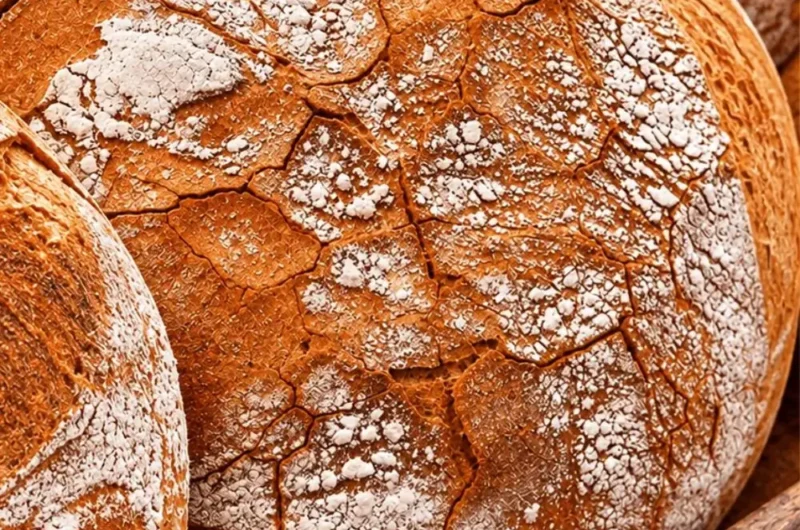
A rustic Italian bread made with biga, yeast and a very wet dough. It bakes into 2 large or 3 smaller round loaves with a crisp, flour-dusted crust and a chewy, open crumb.
12
servings45
minutes5
hours30
minutes375
minutesIngredients
1 1/4 teaspoons (3.5 g) active dry yeast
1/4 cup (60 g) warm water (105°F to 110°F / 40°C to 43°C)
3 cups (720 g) room-temperature water
3/4 cup plus 1 tablespoon (200 g) biga (Italian fermented starter)
7 cups plus 2 tablespoons (1 kg) unbleached all-purpose flour, plus extra for dusting and shaping
4 teaspoons (20 g) kosher salt
Yellow cornmeal, for dusting the baking stones
Directions
- Bloom the yeast: Stir the yeast into the 1/4 cup warm water, 105°F to 110°F (40°C to 43°C), in the bowl of a stand mixer. Leave it for about 10 minutes, until foamy and creamy, which tells you the yeast is alive.
- Add the biga: Pour in the 3 cups room-temperature water and drop in the biga. Beat with the paddle attachment until the mixture is smooth, so the starter spreads evenly through the dough.
- Mix in flour and salt: Add the flour and salt and mix on low speed for 1 to 2 minutes. The dough should turn soft and elastic, pull away from the sides of the bowl, and cling a little to the bottom.
- Knead by hand: If you like, turn the dough onto a floured surface and knead it gently with floured hands for about 1 minute. It’s ready when it feels velvety and is no longer tacky.
- First rise: Move the dough into a large, lightly oiled bowl or dough tub. Cover it tightly with plastic wrap or a lid and leave it at room temperature for about 3 hours, until it has tripled in volume.
- Flour the surface: Dust your work surface and a bench scraper generously with flour. Keep a small pile of extra flour nearby for your hands.
- Divide the dough: Pour the risen dough gently onto the floured surface and dust the top lightly with flour. Cut it into 2 equal pieces for large loaves or 3 equal pieces for smaller ones.
- Pre-shape: Flatten each piece gently, then roll it into a snug log and tuck the dough in with your thumbs as you go. Turn the log a quarter turn, flatten it once more, and roll it up again.
- Form the rounds: Cup your hands around each piece and drag it gently across the unfloured part of the counter. The friction builds surface tension and shapes a tight, smooth round loaf (boule).
- Second rise: Set the loaves on parchment-lined baking sheets or floured pizza peels. Cover them with a heavy kitchen towel and let them rise for about 1 hour, until doubled in size.
- Heat the oven: About 30 minutes before baking, put baking stones on the oven racks and preheat the oven to 450°F (230°C). The stones need that time to get fully hot.
- Dimple the loaves: Dust the tops lightly with flour and press your fingertips gently into the surface all over to make shallow dimples. Rest the loaves uncovered for 5 to 10 minutes, until the dough feels very soft and springs back gently.
- Load the oven: Sprinkle the hot stones lightly with cornmeal and carefully flip each loaf onto a stone, floured side up. If you have no stones, bake the loaves right on the baking sheets.
- Bake until crisp: Two large loaves need 50 to 60 minutes, and three smaller ones need 30 to 35 minutes. You want a deep golden, crisp crust. Tap the bottom, and if it doesn’t sound hollow, give the loaves a few more minutes.
- Cool completely: Move the loaves to wire racks and let them cool all the way before you slice. The crumb is still setting inside, and cutting early makes it gummy.