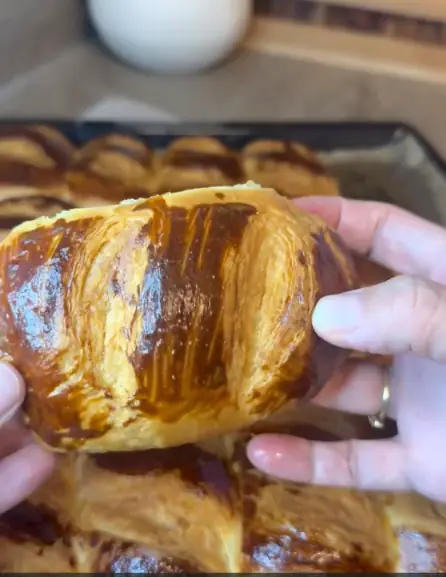
Sweet croissants are flaky, buttery crescents made from a yeast dough, a butter block and three rounds of folding, ready in about 20 hours. The recipe makes 20 croissants and most of that time is hands-off chilling and rising.
Why This Recipe Works
The butter block is pounded cold and mixed with some flour. The flour makes the butter smooth and stiff enough to roll without melting into the dough. That keeps the butter in thin, separate layers.
Each fold and turn stacks more layers of dough and butter. In the oven, the water in the butter turns to steam and pushes the layers apart. That is where the airy, honeycombed crumb comes from.
The long chills do real work. Cold dough rolls out without tearing and the butter stays in sheets instead of smearing. If the dough ever fights you or feels greasy, put it back in the fridge before you go on.
Sweet Croissants Ingredients
For the dough
- 5 teaspoons active dry yeast
- 1 1/2 cups warm water
- 1 stick (4 ounces) unsalted butter, softened at room temperature
- 1/3 cup plus 1 teaspoon granulated sugar
- 2 large eggs
- 2 1/3 cups unbleached all-purpose flour
- 2 1/3 cups bread flour
- 2 1/2 teaspoons salt
For the butter block
- 4 sticks (1 pound) cold unsalted butter
- 1 cup minus 2 tablespoons unbleached all-purpose flour
For the glaze
- 1 large egg, beaten
How To Make Sweet Croissants
Make and chill the dough
- Bloom the yeast: Whisk the yeast into the warm water in a large bowl. Leave it for about 10 minutes, until it looks foamy and creamy. That tells you the yeast is alive.
- Mix the wet ingredients: Beat the 1 stick (4 ounces) softened unsalted butter, the sugar and the eggs into the yeast mixture until everything is combined. Softened butter blends in smoothly, with no cold lumps.
- Form the dough: Whisk the 2 1/3 cups unbleached all-purpose flour, the bread flour and the salt together in a separate bowl. Add them to the wet mixture 1 cup at a time, so the dough comes together evenly and stays soft.
- Knead lightly: Turn the dough onto a lightly floured surface and knead for about 1 minute, roughly 18 to 20 folds, until smooth. Stop there, because overworking makes the croissants tough.
- Let it rise: Put the dough in a lightly oiled bowl and cover it tightly with plastic wrap. Let it rise at room temperature for 1 to 1 1/2 hours, until doubled in size.
- Chill the dough: Turn the dough onto a floured counter and press it down 5 or 6 times to deflate it. Flatten it a little, dust it with flour and wrap it tightly in plastic wrap. Refrigerate for 4 to 6 hours, or overnight, until thoroughly chilled.
Laminate the dough
- Make the butter block: Pound the 4 sticks (1 pound) cold unsalted butter with a rolling pin until it turns pliable and creamy. Use a bench scraper to work in 1/2 cup of the 1 cup minus 2 tablespoons unbleached all-purpose flour. Add the rest and smear until smooth. Shape it into a flat block 1/2 inch thick, wrap it in plastic and chill for 15 to 20 minutes, until firm but still bendable.
- Lock in the butter: Roll the chilled dough into a 20 x 12-inch rectangle, about 1/4 inch thick, with a short edge toward you. Break the butter block into 1/2-inch pieces and scatter them over the bottom two-thirds of the dough. Leave a 1 1/2-inch border around the edges.
- Fold the first letter: Fold the unbuttered top third down over the middle, then fold the bottom third up over that, like a business letter. Pinch the seams shut to seal in the butter. Tap the dough lightly with the rolling pin to spread the butter.
- Turn it twice: Rotate the dough 90 degrees so the top flap faces right. Roll it into a 20 x 12-inch rectangle again, fold it in thirds, pinch the edges and tap it. Rotate once more and repeat. Wrap the dough in plastic and chill for 45 minutes to 1 hour.
- Turn it two more times: Roll the chilled dough into a 20 x 12-inch rectangle and fold it in thirds, pinching the edges shut. Rotate it 90 degrees and do one more roll and fold. Seal the dough in plastic and chill it for at least 4 hours, or overnight. If the dough fights back or the butter softens at any point, chill it before you go on.
Shape and bake
- Cut the triangles: Cut the cold dough into two equal pieces. Take one piece and roll it out to 26 x 8 inches, then trim the edges straight. Mark both long edges every 5 inches with a ruler, then cut diagonally between the marks to make even triangles. Do the same with the second piece.
- Roll the croissants: Set a triangle in front of you with the wide base at the bottom. Stretch the base to 6 or 7 inches wide and the triangle to about 10 inches tall, without pulling on the narrow tip. Roll it up from the base toward the point.
- Let them rise again: Place the croissants on greased or parchment-lined baking sheets and curve the ends slightly inward into a crescent. Drape plastic wrap over them without pressing it down. Leave them for about 2 hours, until they have doubled in size.
- Glaze and bake: Preheat the oven to 425°F (220°C). Brush the tops lightly with the beaten egg. Bake for 6 minutes, then lower the oven to 375°F (190°C) and bake 15 minutes more, until deep golden brown. Cool completely on wire racks before serving.
Recipe Tips
- Keep everything cold: If the butter turns soft or greasy while you roll, wrap the dough and chill it before you continue. Warm butter melts into the dough and you lose the layers.
- Use a light touch: Tap and roll gently, and never pull on the narrow tip of the triangle. Rough handling tears the layers and the croissants bake up dense.
- Brush on the glaze lightly: A thin coat of egg gives an even golden color. Pooling egg drips down the sides and glues the layers together, so they can’t open up.
- Use a ruler: Even triangles bake at the same speed and look alike on the plate. Measure the rectangle and the marks rather than cutting by eye.
What To Serve With Sweet Croissants
Serve them cooled, plain or with butter and jam. They go well with a cappuccino or hot chocolate at a slow weekend breakfast.
How To Store
- Room temperature: Keep cooled croissants in a covered container for up to 2 days.
- Freezer: Freeze baked croissants in an airtight bag for 2 to 3 months. Thaw them at room temperature.
- Reheat: Warm them in a 350°F (175°C) oven for a few minutes to crisp the outside again.
FAQs
Can I make croissant dough ahead of time?
Yes. The recipe already builds in overnight chills after the first rise and after the second round of turns. Keep the dough wrapped tightly in the fridge until you are ready to shape it.
Why did my butter leak out while baking?
This usually means the butter got too warm during rolling, or the croissants were underproofed. Chill the dough whenever the butter feels soft, and let the shaped croissants rise for the full 2 hours.
Can I use only all-purpose flour in the dough?
The recipe uses both all-purpose and bread flour. Bread flour has more protein, which gives the dough strength to hold its layers. Using all-purpose alone will give a softer, less chewy croissant.
Are these croissants vegetarian?
Yes. They contain butter, eggs, flour, yeast and sugar, with no meat or gelatin. They are not vegan or dairy-free, and they contain gluten.
Nutrition
Estimated per serving (1 of 20), worked out from the ingredients.
- Calories: about 330 kcal
- Total Fat: 20g
- Total Carbohydrate: 32g
- Dietary Fiber: 1g
- Protein: 6g

Sweet Croissants
Flaky, buttery croissants made with a yeast dough, a cold butter block and three rounds of folding. The recipe makes 20 golden crescents with a light, layered crumb.
20
servings1
hour30
minutes21
minutes111
minutesIngredients
- For the dough
5 teaspoons active dry yeast
1 1/2 cups warm water
1 stick (4 ounces) unsalted butter, softened at room temperature
1/3 cup plus 1 teaspoon granulated sugar
2 large eggs
2 1/3 cups unbleached all-purpose flour
2 1/3 cups bread flour
2 1/2 teaspoons salt
- For the butter block
4 sticks (1 pound) cold unsalted butter
1 cup minus 2 tablespoons unbleached all-purpose flour
- For the glaze
1 large egg, beaten
Directions
- Bloom the yeast: Whisk the yeast into the warm water in a large bowl. Leave it for about 10 minutes, until it looks foamy and creamy. That tells you the yeast is alive.
- Mix the wet ingredients: Beat the 1 stick (4 ounces) softened unsalted butter, the sugar and the eggs into the yeast mixture until everything is combined. Softened butter blends in smoothly, with no cold lumps.
- Form the dough: Whisk the 2 1/3 cups unbleached all-purpose flour, the bread flour and the salt together in a separate bowl. Add them to the wet mixture 1 cup at a time, so the dough comes together evenly and stays soft.
- Knead lightly: Turn the dough onto a lightly floured surface and knead for about 1 minute, roughly 18 to 20 folds, until smooth. Stop there, because overworking makes the croissants tough.
- Let it rise: Put the dough in a lightly oiled bowl and cover it tightly with plastic wrap. Let it rise at room temperature for 1 to 1 1/2 hours, until doubled in size.
- Chill the dough: Turn the dough onto a floured counter and press it down 5 or 6 times to deflate it. Flatten it a little, dust it with flour and wrap it tightly in plastic wrap. Refrigerate for 4 to 6 hours, or overnight, until thoroughly chilled.
- Make the butter block: Pound the 4 sticks (1 pound) cold unsalted butter with a rolling pin until it turns pliable and creamy. Use a bench scraper to work in 1/2 cup of the 1 cup minus 2 tablespoons unbleached all-purpose flour. Add the rest and smear until smooth. Shape it into a flat block 1/2 inch thick, wrap it in plastic and chill for 15 to 20 minutes, until firm but still bendable.
- Lock in the butter: Roll the chilled dough into a 20 x 12-inch rectangle, about 1/4 inch thick, with a short edge toward you. Break the butter block into 1/2-inch pieces and scatter them over the bottom two-thirds of the dough. Leave a 1 1/2-inch border around the edges.
- Fold the first letter: Fold the unbuttered top third down over the middle, then fold the bottom third up over that, like a business letter. Pinch the seams shut to seal in the butter. Tap the dough lightly with the rolling pin to spread the butter.
- Turn it twice: Rotate the dough 90 degrees so the top flap faces right. Roll it into a 20 x 12-inch rectangle again, fold it in thirds, pinch the edges and tap it. Rotate once more and repeat. Wrap the dough in plastic and chill for 45 minutes to 1 hour.
- Turn it two more times: Roll the chilled dough into a 20 x 12-inch rectangle and fold it in thirds, pinching the edges shut. Rotate it 90 degrees and do one more roll and fold. Seal the dough in plastic and chill it for at least 4 hours, or overnight. If the dough fights back or the butter softens at any point, chill it before you go on.
- Cut the triangles: Cut the cold dough into two equal pieces. Take one piece and roll it out to 26 x 8 inches, then trim the edges straight. Mark both long edges every 5 inches with a ruler, then cut diagonally between the marks to make even triangles. Do the same with the second piece.
- Roll the croissants: Set a triangle in front of you with the wide base at the bottom. Stretch the base to 6 or 7 inches wide and the triangle to about 10 inches tall, without pulling on the narrow tip. Roll it up from the base toward the point.
- Let them rise again: Place the croissants on greased or parchment-lined baking sheets and curve the ends slightly inward into a crescent. Drape plastic wrap over them without pressing it down. Leave them for about 2 hours, until they have doubled in size.
- Glaze and bake: Preheat the oven to 425°F (220°C). Brush the tops lightly with the beaten egg. Bake for 6 minutes, then lower the oven to 375°F (190°C) and bake 15 minutes more, until deep golden brown. Cool completely on wire racks before serving.