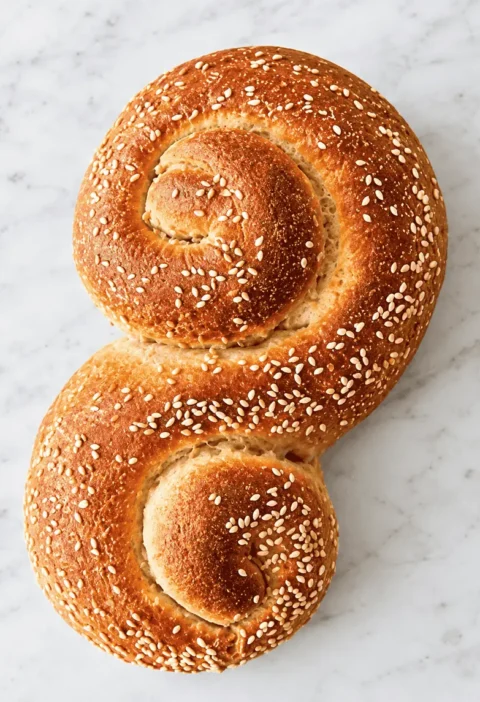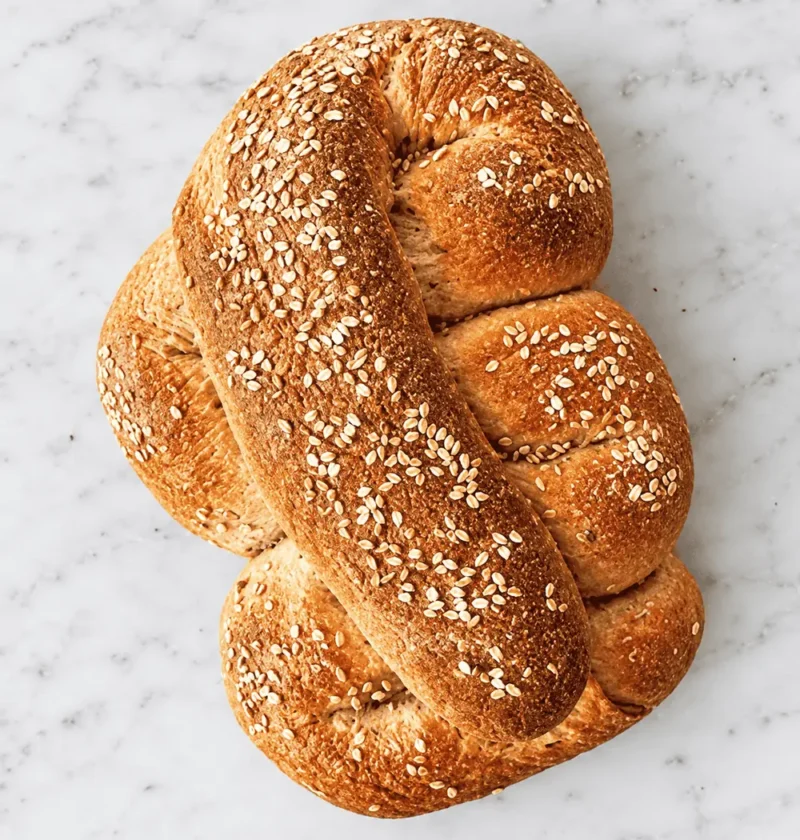
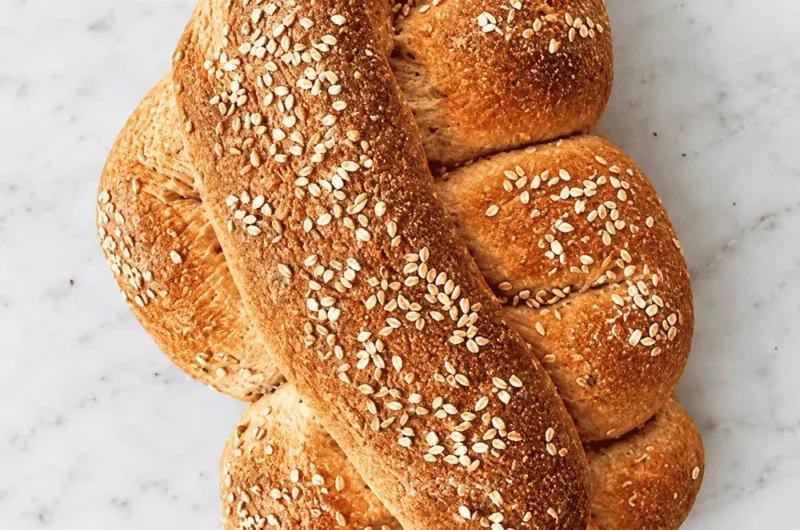
Sicilian sesame mafalda bread makes 2 golden loaves from durum flour, all-purpose flour and sesame seeds, ready in about 5 hours 5 minutes. Most of that is hands-off rising, and the curled snake shape gives you a crisp crust and a soft, chewy inside.
Why This Recipe Works
Durum flour gives the crumb its pale yellow color and a slightly sweet, nutty taste. Mixed with all-purpose flour, it keeps the dough firm and elastic instead of dense. Kneading for 4 to 5 minutes, then finishing by hand, builds enough structure to hold the curled shape.
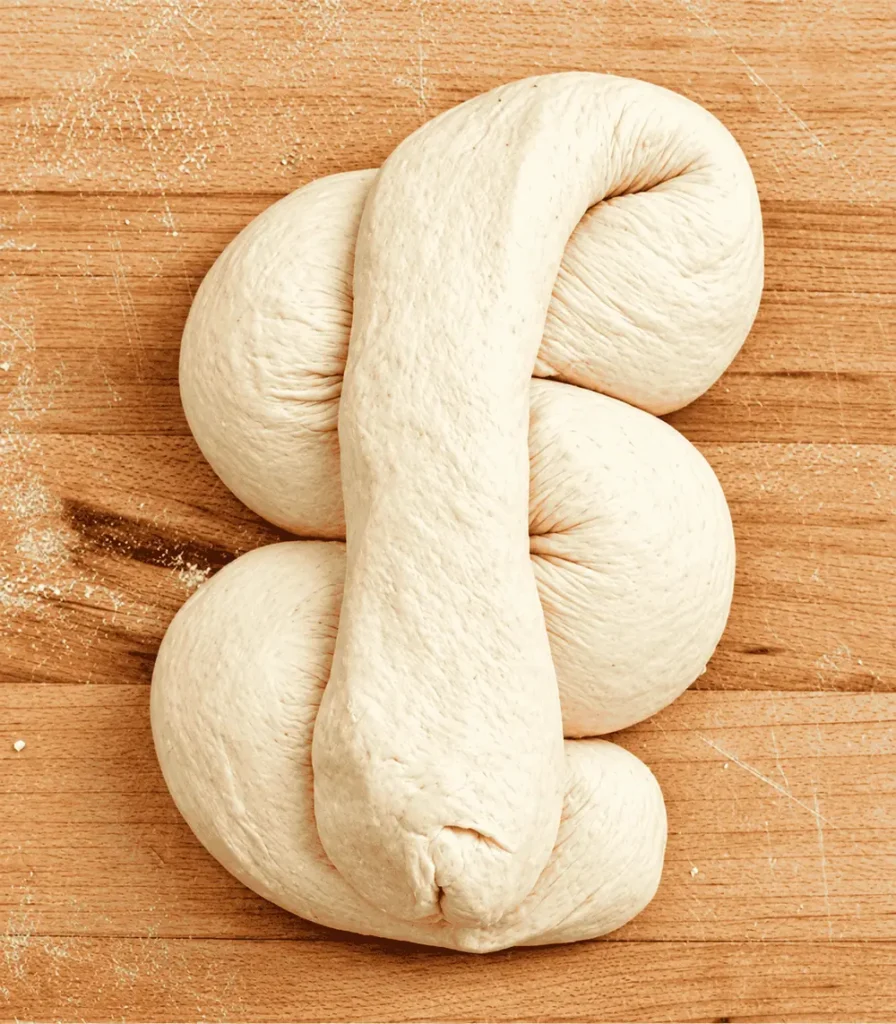
The shape is what makes this a mafalda. Curl the rope back and forth like a snake, then lay the free tail across the top without stretching it. Don’t tuck the tail underneath, or the loaf won’t rise properly in the oven.
A brush of water gives the sesame seeds something to stick to, so they don’t fall off when you slice. Spraying the oven with cold water in the first 10 minutes makes steam. Steam keeps the crust soft long enough for the loaf to rise fully before it sets and turns golden.
Sicilian Sesame Mafalda Bread Ingredients
- 2 1/4 teaspoons (1 package) active dry yeast
- 1/4 cup (60 g) warm water
- 1 tablespoon olive oil
- 1 teaspoon malt syrup or malt powder (optional)
- 1 cup (240 g) room-temperature water
- About 2 1/2 cups (350 g) durum flour
- 1 cup plus 1 tablespoon (150 g) unbleached all-purpose flour
- 2 to 3 teaspoons salt
- 1/3 cup (40 g) sesame seeds
- Cornmeal, for the baking stones
How To Make Sicilian Sesame Mafalda Bread
Make the dough
- Activate the yeast: Stir the yeast into the 1/4 cup warm water in a large mixer bowl. Let it stand for about 10 minutes, until creamy, which tells you the yeast is alive.
- Mix the liquids: Add the room-temperature water, the olive oil, and the malt syrup if you’re using it. Blend with the paddle attachment.
- Add the dry ingredients: Add the durum flour, all-purpose flour and salt, plus the malt powder if that’s what you chose. Mix until the dough looks smooth.
- Knead: Switch to the dough hook and knead on medium speed for 4 to 5 minutes. The dough should feel firm, compact and elastic. Finish with a short knead by hand on a lightly floured surface.
- First rise: Put the dough in a lightly oiled bowl and cover it tightly with plastic wrap. Let it rise for about 1 1/2 hours, until doubled, springy and blistered but still soft.
Shape the loaves
- Roll the rope: Press the air out of the risen dough, give it a quick knead, then leave it alone for 5 minutes so it relaxes. Pat it into a square with your forearm and roll it into a narrow rope 20 to 22 inches long. Cut the rope in half.
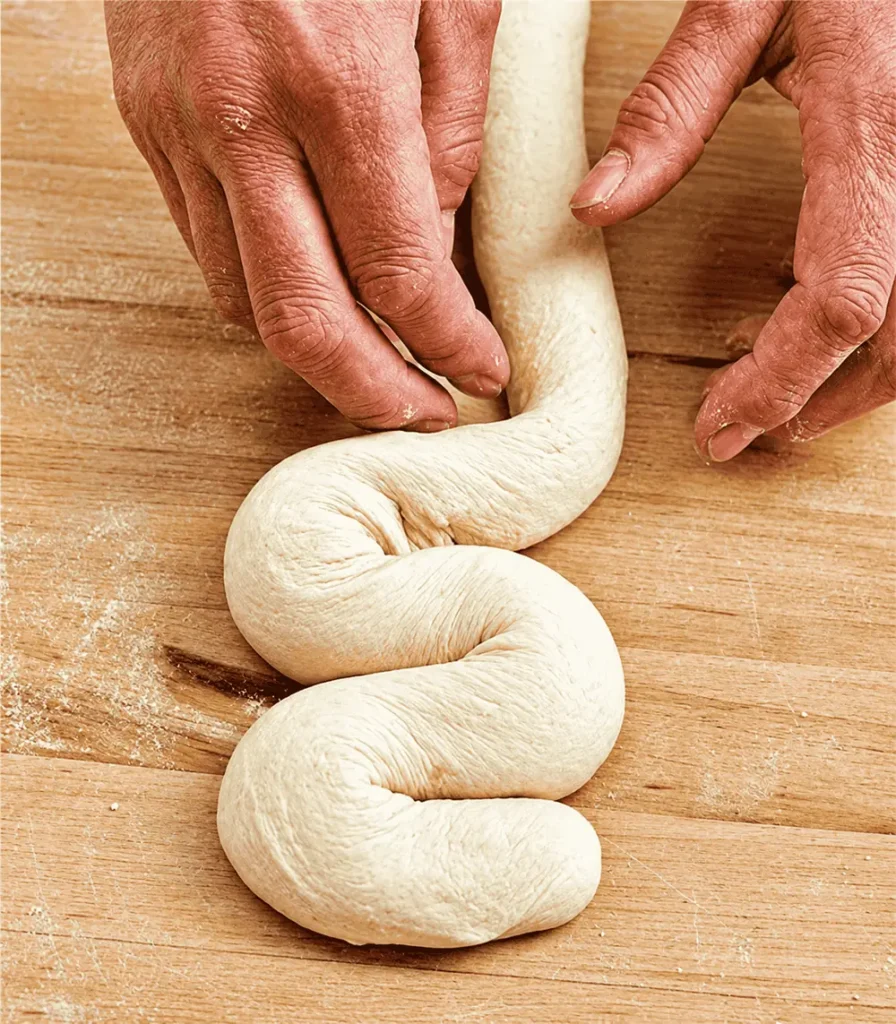
- Curl the snake: Take one rope and curl it back and forth on itself like a snake. Leave a 5-inch tail free at one end.
- Lay the tail: Lay the tail across the top of the curls like a baton, without stretching it. Don’t tuck it underneath, or the loaf won’t rise properly. Repeat with the second rope.
- Seed the loaves: Transfer each loaf to its resting spot: a sheet of floured parchment, a cornmeal-dusted peel, or an oiled baking sheet all work. Brush the loaves lightly all over with water, sprinkle with the sesame seeds, and pat the seeds in gently so they stick.
- Second rise: Cover the loaves with plastic wrap and a kitchen towel. Let them rise for 1 to 1 1/2 hours, until doubled.
Bake
- Heat the oven: Thirty minutes before baking, heat the oven to 425°F (220°C) with the baking stones inside. A hot stone gives the loaves a strong start.
- Bake with steam: Dust the hot stones with cornmeal so the bottoms don’t stick, then slide the loaves on. Bake them for the first 10 minutes, and during that time mist the oven with cold water three times to make steam.
- Finish baking: Lower the heat to 400°F (200°C). Bake for 25 to 30 minutes more, until the loaves are golden brown.
- Cool: Move the loaves to wire racks to cool. Air under the loaf keeps the bottom crust crisp.
Recipe Tips
- Watch the dough, not the clock: Rising times shift with the temperature of your kitchen. The first rise is done when the dough has doubled and looks springy and blistered, not at exactly 1 1/2 hours.
- Handle the tail gently: Lay it on top without pulling it tight. A stretched tail tears or shrinks back, and the shape loses its definition.
- Spray quickly: Open the oven door only long enough to spray, then close it right away. Each long opening lets the heat and steam escape.
- Salt to your taste: The recipe gives 2 to 3 teaspoons. Start at 2 teaspoons if you’re careful with salt, and use 3 if you like a well-seasoned crumb.
What To Serve With Sicilian Sesame Mafalda Bread
Slice the loaves thick and serve them with soup, a roasted vegetable plate, or a board of cheese and olives. Leftover slices make a sturdy base for toasted sandwiches.
How To Store
- Counter: Keep the cooled loaves in a paper bag or wrapped in a clean kitchen towel for up to 2 days. A plastic bag softens the crust.
- Freezer: Wrap a fully cooled loaf tightly and freeze it for up to 3 months. Thaw it at room temperature, then warm it in the oven for 10 minutes to bring back the crust.
FAQs
What is durum flour and can I leave it out?
Durum flour is milled from hard durum wheat, the same wheat used for dried pasta. It gives the bread its yellow crumb and nutty flavor. You can swap in more all-purpose flour, but the color and taste will be milder.
Do I need to use malt syrup or malt powder?
No, it’s optional. Malt feeds the yeast and helps the crust brown, but the bread still bakes well without it.
Can I bake these loaves without baking stones?
Yes. Bake them on oiled baking sheets and use the same temperatures and times. The bottom crust won’t be quite as crisp as it is on a hot stone.
Why did my mafalda loaf spread flat instead of rising?
The most common cause is tucking the tail under the curls, which blocks the rise. Over-proofing the shaped loaves can also make them collapse, so bake them once they’ve doubled.
Nutrition
Estimated per serving (1 of 2), worked out from the ingredients.
- Calories: about 160 kcal
- Total Fat: 4g
- Total Carbohydrate: 26g
- Dietary Fiber: 2g
- Protein: 5g
Sicilian Sesame Mafalda Bread
Two golden Sicilian loaves made with durum flour and shaped into a curled snake with a sesame seed crust. Crisp outside and soft inside, with most of the time spent letting the dough rise.
2
servings3
hours30
minutes40
minutes250
minutesIngredients
2 1/4 teaspoons (1 package) active dry yeast
1/4 cup (60 g) warm water
1 tablespoon olive oil
1 teaspoon malt syrup or malt powder (optional)
1 cup (240 g) room-temperature water
About 2 1/2 cups (350 g) durum flour
1 cup plus 1 tablespoon (150 g) unbleached all-purpose flour
2 to 3 teaspoons salt
1/3 cup (40 g) sesame seeds
Cornmeal, for the baking stones
Directions
- Activate the yeast: Stir the yeast into the 1/4 cup warm water in a large mixer bowl. Let it stand for about 10 minutes, until creamy, which tells you the yeast is alive.
- Mix the liquids: Add the room-temperature water, the olive oil, and the malt syrup if you’re using it. Blend with the paddle attachment.
- Add the dry ingredients: Add the durum flour, all-purpose flour and salt, plus the malt powder if that’s what you chose. Mix until the dough looks smooth.
- Knead: Switch to the dough hook and knead on medium speed for 4 to 5 minutes. The dough should feel firm, compact and elastic. Finish with a short knead by hand on a lightly floured surface.
- First rise: Put the dough in a lightly oiled bowl and cover it tightly with plastic wrap. Let it rise for about 1 1/2 hours, until doubled, springy and blistered but still soft.
- Roll the rope: Press the air out of the risen dough, give it a quick knead, then leave it alone for 5 minutes so it relaxes. Pat it into a square with your forearm and roll it into a narrow rope 20 to 22 inches long. Cut the rope in half.
- Curl the snake: Take one rope and curl it back and forth on itself like a snake. Leave a 5-inch tail free at one end.
- Lay the tail: Lay the tail across the top of the curls like a baton, without stretching it. Don’t tuck it underneath, or the loaf won’t rise properly. Repeat with the second rope.
- Seed the loaves: Transfer each loaf to its resting spot: a sheet of floured parchment, a cornmeal-dusted peel, or an oiled baking sheet all work. Brush the loaves lightly all over with water, sprinkle with the sesame seeds, and pat the seeds in gently so they stick.
- Second rise: Cover the loaves with plastic wrap and a kitchen towel. Let them rise for 1 to 1 1/2 hours, until doubled.
- Heat the oven: Thirty minutes before baking, heat the oven to 425°F (220°C) with the baking stones inside. A hot stone gives the loaves a strong start.
- Bake with steam: Dust the hot stones with cornmeal so the bottoms don’t stick, then slide the loaves on. Bake them for the first 10 minutes, and during that time mist the oven with cold water three times to make steam.
- Finish baking: Lower the heat to 400°F (200°C). Bake for 25 to 30 minutes more, until the loaves are golden brown.
- Cool: Move the loaves to wire racks to cool. Air under the loaf keeps the bottom crust crisp.